Introduction
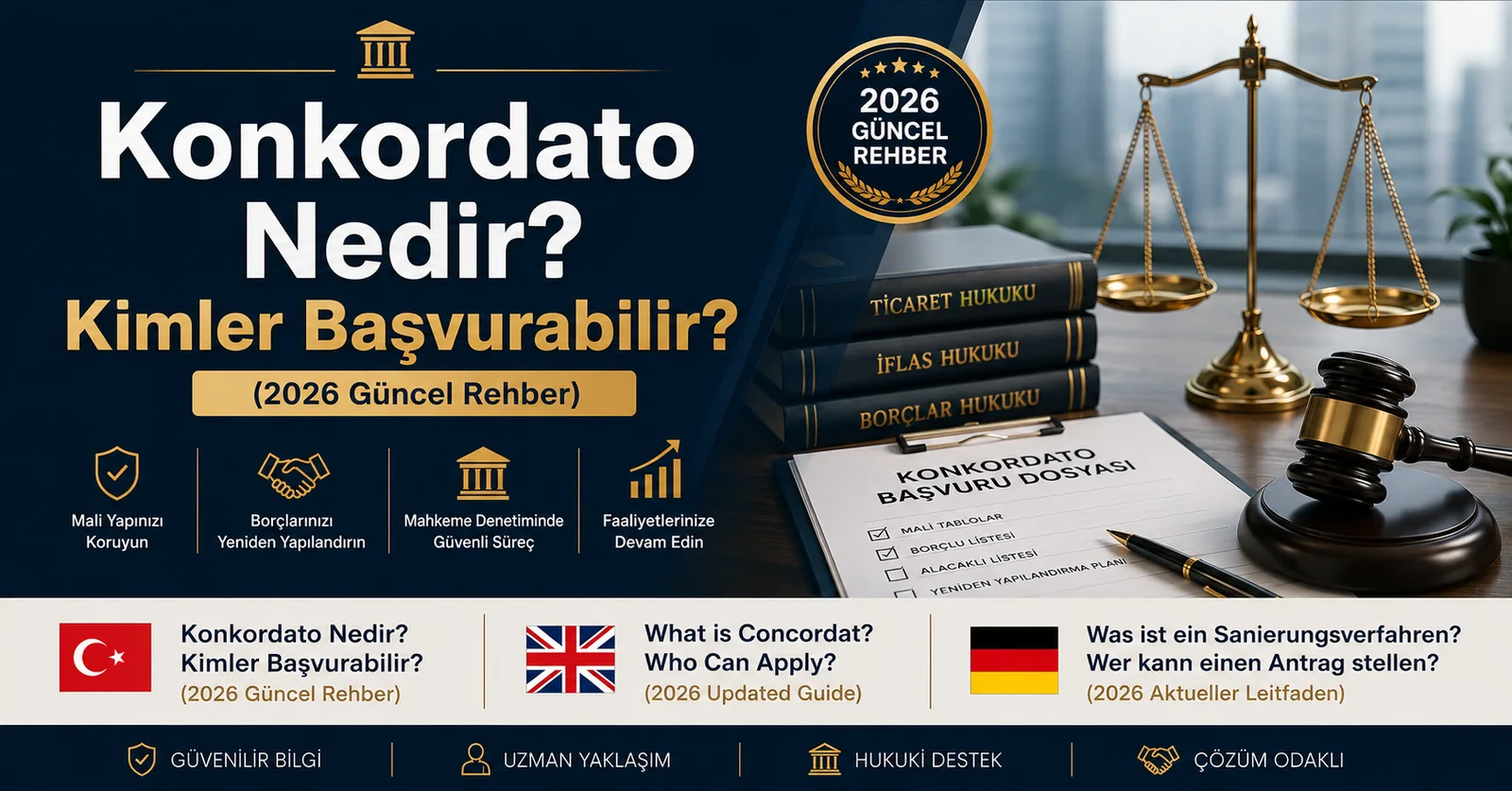
In recent years, due to economic fluctuations, concordat has become one of the most discussed legal institutions in commercial life. Nevertheless, it is still widely misunderstood and often confused with bankruptcy.
In reality, concordat is a legal restructuring mechanism that enables financially distressed businesses to reorganize their debts under court supervision without immediately terminating their commercial activities.
This guide explains what concordat is, who may apply, how the process works and the fundamental legal principles governing the procedure.
What is Concordat?
Concordat is a judicial debt restructuring process allowing debtors experiencing financial difficulty, or facing the risk of insolvency, to restructure their debts with creditors under court supervision.
The primary objectives are:
Ensuring the continuation of commercial activities
Protecting creditors' interests
Preventing bankruptcy whenever possible
Restoring financial stability
Concordat vs Bankruptcy
Although frequently confused, these are fundamentally different legal mechanisms.
Concordat
Business operations continue.
The aim is business recovery.
Debts are restructured.
The process is supervised by the court.
Bankruptcy
Liquidation generally begins.
Assets are distributed.
Bankruptcy rules apply.
Therefore, concordat serves as a preventive restructuring mechanism before bankruptcy.
Who May Apply?
Depending on legal requirements:
Merchants
Joint stock companies
Limited liability companies
Sole proprietorships
Certain individuals
may apply for concordat protection.
However, approval is never automatic. The competent Commercial Court evaluates the financial statements and restructuring project before rendering a decision.
How Does the Process Work?
Generally, the procedure consists of five stages.
Application
The debtor submits financial documents together with the restructuring project.
Temporary Period
If legal conditions are met, the court grants a temporary period and appoints a concordat commissioner.
Definitive Period
After detailed examination, the court may grant a definitive period allowing the restructuring process to continue.
Creditors' Review
Creditors evaluate the proposal and statutory voting thresholds become important.
Court Approval
If all legal conditions are satisfied, the court approves the concordat.
Can Business Operations Continue?
Yes.
The purpose of concordat is to allow the company to continue operating while restructuring its debts.
However, certain transactions remain subject to court supervision and the concordat commissioner.
Creditors' Rights
Creditors have several statutory rights, including:
Filing claims
Examining the restructuring proposal
Raising objections
Exercising other legal remedies provided by law
Is Every Application Approved?
No.
The court carefully evaluates:
Financial statements
Liquidity
Debt repayment capacity
Feasibility of the restructuring project
Creditors' interests
before making its decision.
Frequently Asked Questions
Does a company close after applying?
No.
The objective is to preserve business continuity whenever possible.
Are debts erased?
No.
Debts are reorganized according to the approved restructuring plan.
How long does the procedure take?
The duration depends on the complexity of the case and judicial proceedings.
Conclusion
Concordat is one of the most important restructuring mechanisms available under Turkish insolvency law. Every application is assessed individually according to the debtor's financial condition and statutory requirements.
This article is intended solely for general informational purposes and should not be considered legal advice.